This page is a stub. It will be expanded to a full guide in the future!
Holographic Chocolate
Diffractive optics you can eat!
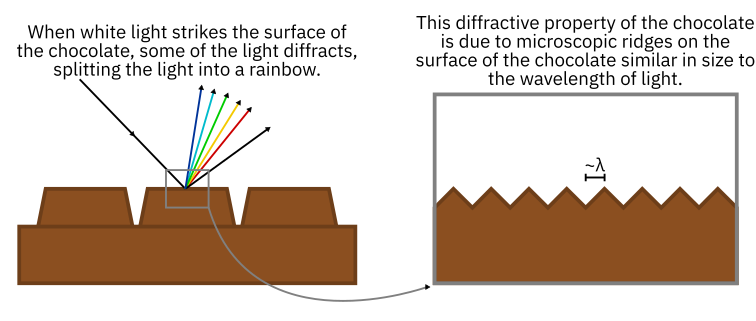
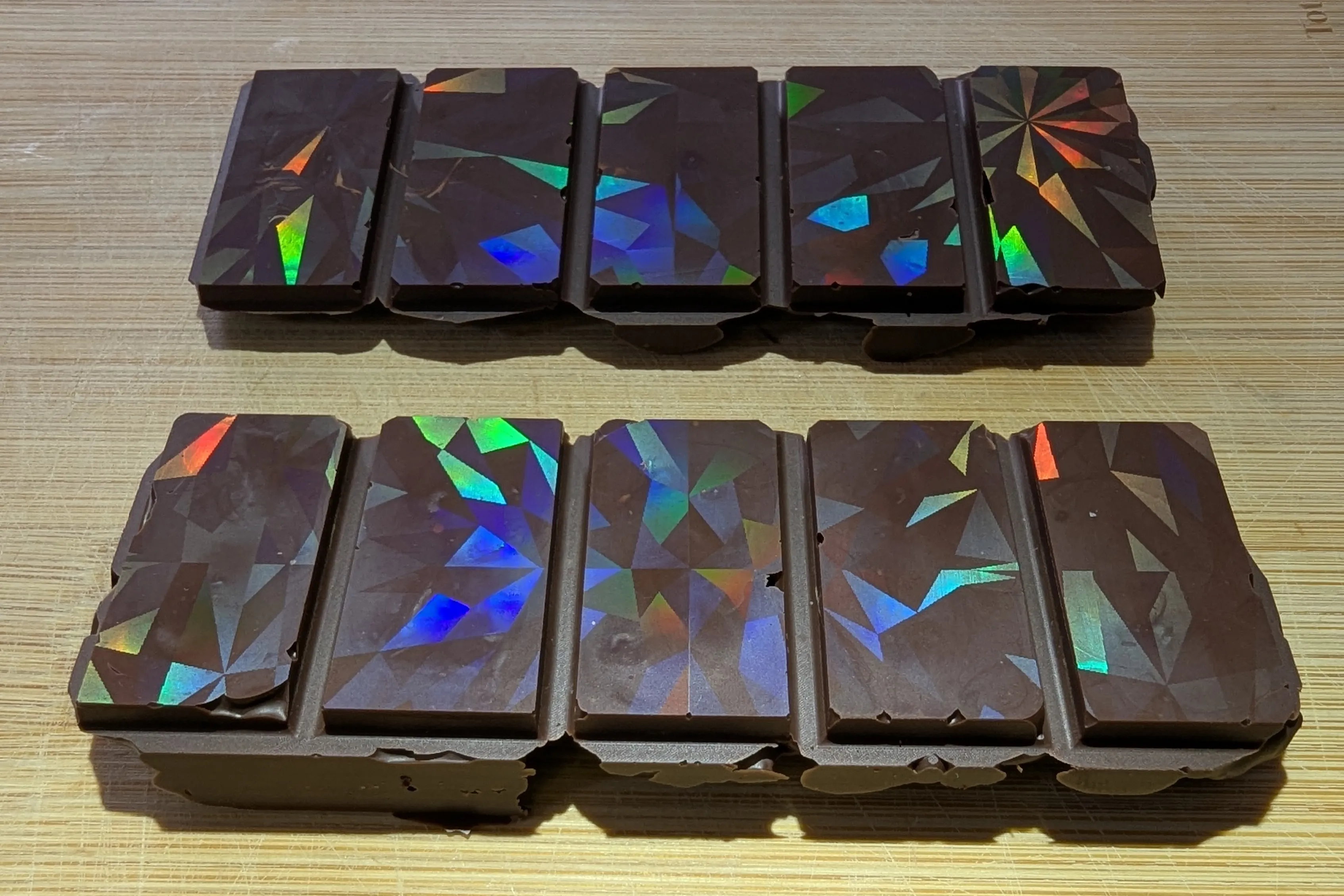
Most objects in our daily lives look a particular color because of the material they’re made of. However, in special situations, the colors we see can be purely due to the structure or geometry of an object, independent of what the object is actually made of. These chocolates provide the perfect (and edible!) example of this. The vibrant iridescent colors on the surface of the chocolate come entirely from light diffracting off of microscopic patterns in the surface of the chocolate. Due to the fragility of this pattern, these chocolates do not keep or ship well, and the only real way to get these is by making them yourself using a special (but inexpensive) mold. Doing this requires carefully tempering the chocolate, providing a secondary lesson about polymorphs/crystal phases!
This project uses off-the-shelf molds which come with a small variety of generic patterns. One day, we would like to make our own custom molds with patterns specific to our student organization. This entails first making a “master” from which silicone molds can be made. Making this master requires either analog holography methods or some (likely lithographic) method to fabricate computer-generated holograms.